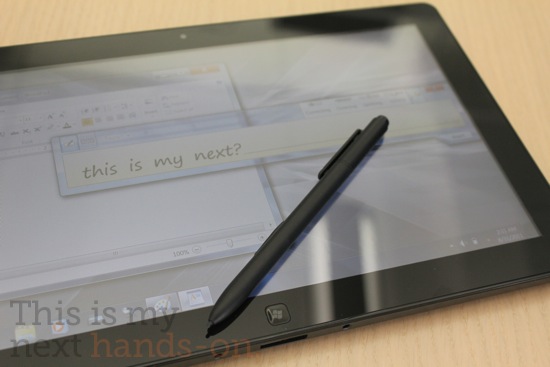
In November I finally realised I could not live with a 64 GB hard drive on my work computer any more. Juggling space on a daily basis is getting me by, but not leading to a stress free working environment. I plumped for the surface pro 2 even though it is a bit smaller than I would like. This was because of all the devices out there this was the one with the most acceptable performance and the best support.
Yesterday I chased its arrival to be told I would not see it until March. Either they are very popular or there is some form of issue or direction change on the cards with the new Microsoft CEO joining soon. I decided then to look around again and though the market has expanded all of the tablet computers have the same issue, they seem to have been designed as toys.
This is a legacy of the iPad having become the default concept of a tablet. Tablets today are great for playing games and reading books but not the sort of device you'd want to work on for any amount of time. Yet the press keep predicting the decline of the PC. How can this happen? Tablet PC's and Apps in general do not yet have the ability to deliver what "Windows Legacy applications" can. I mean can you see yourself forecasting your business spend on the kind of spreadsheet application you see on a tablet? Do you really think you could work that way?
Someday soon someone is going to combine a proper pen with a decent sized tablet and realise that this would make a good platform to really work on. I thought I'd found such a thing in the Dell XPS18 but alas they had not included a proper pen and writing with a rubber tipped one is so unsatisfying. Until then I guess I hang on and wait for my surface pro 2, soon though my eyes are not going to be good enough to cope with such small writing.....
Saturday, February 1, 2014
Saturday, September 28, 2013
Office 365 is going to be the end of my tablet
It's not applications that have caused this but our upgrade from the wave 14 to wave 15 version of Office 365. Along with this upgrade came a much expanded and more efficient SkyDrive Pro and our adoption of online Sharepoint has rocketed. This in turn has meant that I have many more document libraries that are marked to synchronise with my tablet. This makes accessing documents shared in Sharepoint possible even when working on the train, which is pretty much the only time I get to work solidly for an hour or so!
The problem for my tablet is that I now struggle to fit the documents I want on it. I now have to juggle whether to take it to pieces and add a larger mSata hard drive or whether to talk sweetly to my boss and mention how much more efficient I would be with a 512GB Surface Pro 2.
Tuesday, July 30, 2013
Simplify Unix and dominate the world
Today I began musing on the place of Unix within the computing world. When I first began working in IT it was clear Unix would be a minority operating system for bigger more powerful systems. A few years latter I began to use a product called Knopix a Unix variant and in the Mid 90's first encountered Linux, but these were command line programs difficult to install and use. That is difficult if you were not pretty technically competent.
Linux and the other "free" Unixs have developed immeasurably since those days. Ubuntu is really easy to deploy and use, but even so they remain fairly tightly focused on the technology savvy users list and it takes patience to learn to do all that you would wish to achieve. The Unix desktop is clearly not going to replace the PC anytime soon or anytime ever, and yet it now pretty much dominates the computing marketplace.
I don't think this would have been foreseen but both IOS and Android have Unix at their core and overall far more computing is now done on these platforms than is done on PC platforms. Suddenly the world has turned on its head and this has happened because first Apple and then Google realised these OSs had the potential, if you shielded the user from the complexity. Shielding the user from complexity should be the first thing we do in the IT world because we are about enabling their ability to work but before the iPhone people just missed this obvious point. Cloud computing plays to this too and the whole thing begins to assemble into a working way for the future.
Fighting complexity should be the first thought of an IT professional especially if they are architects or solutions designers. Simple systems will result in better usability, smoother more easily managed services and a reduction in cost. Think about this next time you review a solution, just ask if you think your Mum or your Grandmum could work it. If she could you may be on to a winner.
Linux and the other "free" Unixs have developed immeasurably since those days. Ubuntu is really easy to deploy and use, but even so they remain fairly tightly focused on the technology savvy users list and it takes patience to learn to do all that you would wish to achieve. The Unix desktop is clearly not going to replace the PC anytime soon or anytime ever, and yet it now pretty much dominates the computing marketplace.
I don't think this would have been foreseen but both IOS and Android have Unix at their core and overall far more computing is now done on these platforms than is done on PC platforms. Suddenly the world has turned on its head and this has happened because first Apple and then Google realised these OSs had the potential, if you shielded the user from the complexity. Shielding the user from complexity should be the first thing we do in the IT world because we are about enabling their ability to work but before the iPhone people just missed this obvious point. Cloud computing plays to this too and the whole thing begins to assemble into a working way for the future.
Fighting complexity should be the first thought of an IT professional especially if they are architects or solutions designers. Simple systems will result in better usability, smoother more easily managed services and a reduction in cost. Think about this next time you review a solution, just ask if you think your Mum or your Grandmum could work it. If she could you may be on to a winner.
Tuesday, July 23, 2013
The Kraken wakes
One of the key drivers for the message from Steve Ballmer is the nearly 1 billion pound write off of the Windows RT tablets. Everyone that I have talked to in the last year or two was well aware this was yet another knee jerk reaction to Apple and most of us knew this would bomb. A windows PC that did not run windows software was going to fail, in much the same way as the linux netbooks did. Even now, almost a year after Windows 8 was launched there is still not a native Facebook application for the platform!
The recent release the new XBox One displayed the same arrogant set of we know better hallmarks Microsoft has been famous for recently. This was followed by a series of rapid turn arounds as they suddenly realised they had just ditched their "hook" from their customers at the same time as delivering serious upset.
Now I read that Microsoft is ditching product groups to go back to a functional organisation structure. This will be a significant change for them and perhaps shows they have at last realised that we are no longer in thrall to them. This is really good news for all of us, this could be the giant reawakening and turning to truly face the threat. Make no mistake that threat is huge, between the Cloud, Apple and Google the space is getting thinner and thinner. Microsofts key benefits though are still hanging in there, it's not too late for them to realise the true value of windows and stop copying Apple.
I truly love my 18 month old Samsung Series 7 tablet it was great on Windows 7 and okay on Windows 8 but on either is much more of a tablet than an iPad. Had they just stayed focused on devices like the first ever windows tablet I used in 2003/4 (above picture) then maybe things would have been different. I really hope that the lesson has been learned, but I fear that it is just more rhetoric.
Friday, January 4, 2013
The last time I found time to post in my blog it was pre the release of Windows 8. Jump forward nearly 4 months and things have changed greatly. Windows 8 has been released and earlier in the week it was pointed out that it's adoption rate for the same period is much lower than the Vista version of Windows. Vista was disliked by many even though I do not believe it deserved its reputation. We should note that at this time in its adoption its reputation would not have built so it was still a great white hope, much as Windows 8 is today.
At this point every computer in my house is running Windows 8, and still it receives a mixed reception from the family. Both of my boys returned home for Christmas from University, and both refused the offer of a free upgrade (paid for prenatally) to windows 8. Their viewpoint was that they wanted their computers to work.
This is not entirely fair as I have found Windows 8 to be very reliable, quick to start and to use. It is just extremely quirky to use! Many face book friends have tried to talk me into using a start button replacement product saying it makes it usable. I see this in the same way as I saw the users of convertible tablets parading their benefits as a laptop they could use as a tablet later.....and never did. I and my wife soldier on with the standard windows interface, hoping that one day the Windows 8 apps will actually be useful. Currently the machines are all but unusable unless you frequently resort to "Legacy applications" and this will ensure that these applications remain.
Truth is that on my Samsung Series 7 Slate updating to windows 8 made me less productive. The ridiculous non re sizable appleesque on screen keyboard pops up over most of the screen making editing on the move almost impossible. It is particularly frustrating when you are attempting to right click and the keyboard keeps appearing and clearing the menu I am actually trying to access. In addition where the pen was once a first class citizen in Windows it is now much more of an afterthought, when it should have been a USP, a casualty of a Microsoft that believes that copying Apple will get its mojo back.
If you can survive the quirky ways of working and the almost non existent "windows 8 apps" (really no facebook app still!!!) then windows 8 is not so bad. Office 13 though is probably not something you want to get me started on.....
At this point every computer in my house is running Windows 8, and still it receives a mixed reception from the family. Both of my boys returned home for Christmas from University, and both refused the offer of a free upgrade (paid for prenatally) to windows 8. Their viewpoint was that they wanted their computers to work.
This is not entirely fair as I have found Windows 8 to be very reliable, quick to start and to use. It is just extremely quirky to use! Many face book friends have tried to talk me into using a start button replacement product saying it makes it usable. I see this in the same way as I saw the users of convertible tablets parading their benefits as a laptop they could use as a tablet later.....and never did. I and my wife soldier on with the standard windows interface, hoping that one day the Windows 8 apps will actually be useful. Currently the machines are all but unusable unless you frequently resort to "Legacy applications" and this will ensure that these applications remain.
Truth is that on my Samsung Series 7 Slate updating to windows 8 made me less productive. The ridiculous non re sizable appleesque on screen keyboard pops up over most of the screen making editing on the move almost impossible. It is particularly frustrating when you are attempting to right click and the keyboard keeps appearing and clearing the menu I am actually trying to access. In addition where the pen was once a first class citizen in Windows it is now much more of an afterthought, when it should have been a USP, a casualty of a Microsoft that believes that copying Apple will get its mojo back.
If you can survive the quirky ways of working and the almost non existent "windows 8 apps" (really no facebook app still!!!) then windows 8 is not so bad. Office 13 though is probably not something you want to get me started on.....
Saturday, September 15, 2012
Paused waiting for the start
Very soon now we will see the official launch of Microsoft's Windows 8 product. Many observers like myself can see that this will be a significant milestone in computing and a critical juncture for Microsoft and also for Intel, both have a lot riding on this.
The new OS is an attempted balance between a tablet OS and a desktop OS. It has schizophrenic qualities however with neither being quite as pure as they should be. The real challenge for Microsoft is that their RT version, that runs on non Intel processors like the ARM will also not run traditional Windows programs. This means that there are really two versions of Windows, it is quite possible that people will buy a Windows tablet and it will not run the program that they wish to run.
This has happened before with Netbooks. People would buy a Linux Netbook because of the low price and then find it would not run the software they wanted. There was an extremely high proportion of these returned and I believe that many of the cheap Windows 8 devices will suffer the same fate as people buy it because it is windows only to find it cannot run their current software. This will help to thoroughly disenchant the buying public. This confusion will not happen in the corporate market because IT professionals understand the distinction and will specify the correct devices. In addition businesses are used to paying the right money for the right tool.
Windows 8 then attempts to graft an iPad style tablet into your everyday workhorse so that you can both carry out your day job and have a media consumption device. This though has problems, the first being the type of application that you run on a personal tablet is often the type of application businesses prefer you not to use e.g. facebook. The second is the availability of the Windows 8 Apps.
Windows 8 Apps are different from Windows 8 programs and will need to be developed. The challenge here is that this is a third ecosystem that developers would need to support. Despite the number of deployed Android devices being huge, probably bigger than the number of deployed Windows 8 devices will ever be, I still have to wait for Android versions of most applications. Inevitably an iPad version is released first, and exists for a considerable amount of time before the equivalent Android app, if an Android app ever arrives. I suspect that a Windows 8 version will naturally queue up behind the Android version, especially if you take into account the immaturity of the Windows 8 market place etc.
If Windows 8 does not find traction quickly it could fail, in a similar way to how Vista failed. The world is very different now though to when Vista was released and recovery from this would be much more difficult.
There are a lot of good things going on in Microsoft at the moment though and there are the signs of a really comprehensive overall solution. If the integration between the new OS, the cloud, the mobile and the entertainment console is combined just right this could be a significant change to our world. It is a tough one to pull off though and it requires a simplicity of use that Microsoft have not often demonstrated. I'm looking forward to seeing what happens with bated breath...
Saturday, June 30, 2012
Most people, driven by the news and Apple themselves, believe that the iPad was the first ever tablet, but the start of the tablet revolution was much earlier than that. Though I used and enjoyed the HP tablet shown below even I was not aware of the Fidler Tablet until I saw this picture. What this shows though is that it is not only the idea that needs to be right, the market needs to be ready for the idea. This has showed up many times in the technology market (Remember the Apple Newton?) because of the speed of technology development.
In 2003/4 when I started talking about people having a allowance to buy their own computer for work it is clear that though people liked the idea and thought it to be the right way to go. They really were not bought in to making it work though. Nowadays this concept has been labelled BYOD and everyone is talking about it, but are they any more ready for the idea?
I work in an environment where it is probably more important to embrace this concept than any other yet it is clear to me we are far from ready to truly make it work. This is not because we are not willing, or because we do not have the skills. It is simply that the products and the environment do not yet make this work easily.
Take for example licensing, if I am using my own tablet for the companies work who should own and pay for the software? If the software I am using is not properly licensed who should be responsible, me because I own the computer or my company because they need me to use it? I would argue if I am given an allowance to equip myself I should use this to buy the right things and be compliant and thus I am responsible. From a software companies point of view though recovering costs for stolen software from an individual is much more difficult.
I believe this is what will drive software more and more towards the cloud making it less dependant on the hardware. That way the company will pay for the access to the on-line software and the employee can use it for as long as they work for the company. Many software companies have already started to go this way and with browsers becoming more and more in touch with the hardware on the local machine it will not be too long before the majority of software is delivered this way. Those companies that cannot deliver their software through web techniques will provide gateways to arrays of instances running their software. To most users this will be indistinguishable from using the web techniques.
This is really just as well as in the last couple of weeks Microsoft, Google and Amazon have unveiled new tablet devices that will inevitably replace the PC for the majority of users.
Subscribe to:
Posts (Atom)